
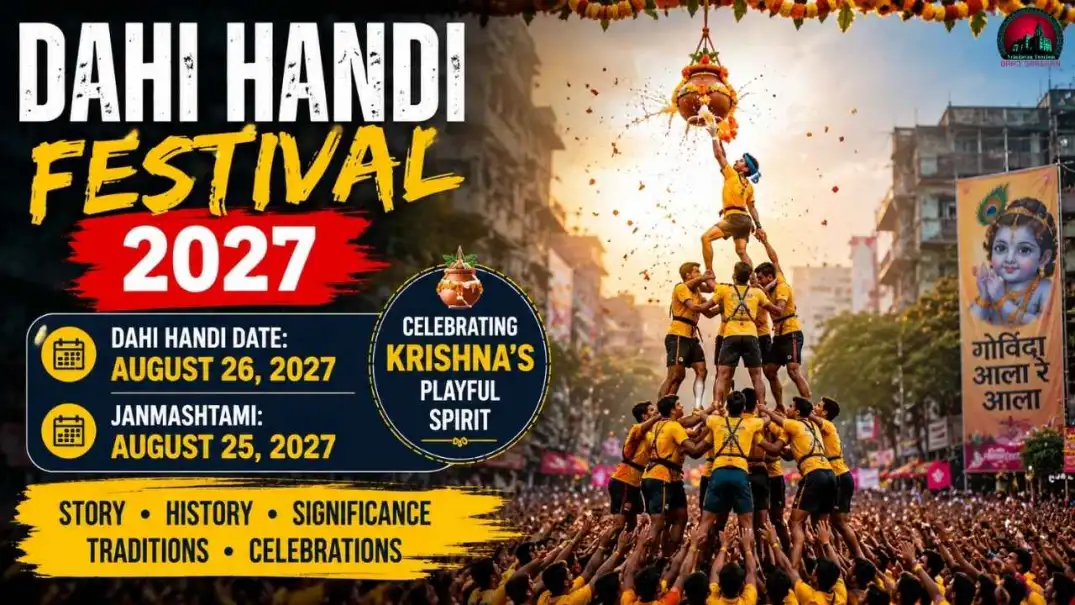
Dahi Handi Festival 2027 will be celebrated on Thursday, August 26, 2027, the day after Krishna Janmashtami. Krishna Janmashtami will fall on Wednesday, August 25, 2027. Dahi Handi is one of the most energetic traditions associated with Lord Krishna's childhood and is especially famous in Maharashtra, where Govinda teams form human pyramids to reach and break a clay pot suspended high above the ground.
The festival combines devotion, tradition, music, teamwork and community celebration. Although Dahi Handi is celebrated in several parts of India, Maharashtra—particularly Mumbai, Thane and Pune—is known for some of the largest and most competitive celebrations.
Dahi Handi Festival 2027 Quick Answer
|
Information
|
Details
|
|
Festival
|
Dahi Handi
|
|
Year
|
2027
|
|
Dahi Handi Date
|
Thursday, August 26, 2027
|
|
Janmashtami Date
|
Wednesday, August 25, 2027
|
|
Also Known As
|
Gopalkala, Govinda
|
|
Mainly Celebrated In
|
Maharashtra and other parts of India
|
|
Main Participants
|
Govindas / Govinda Pathaks
|
|
Main Tradition
|
Forming a human pyramid and breaking a hanging handi
|
|
Associated With
|
Lord Krishna's childhood butter-stealing pastimes
|
Dahi Handi is traditionally connected with the day following Krishna Janmashtami, although local customs and event timings can vary by region.
When Is Dahi Handi in 2027?
Dahi Handi will be celebrated on Thursday, August 26, 2027.
The celebration follows Krishna Janmashtami, which will be observed on Wednesday, August 25, 2027. According to the 2027 Hindu calendar calculations, the Ashtami tithi associated with Janmashtami ends on August 25, followed by the Dahi Handi celebration on August 26.
This is an important distinction for anyone planning to attend the celebrations because Janmashtami and Dahi Handi are closely connected but are not necessarily the same day's event.
Dahi Handi 2027 Date & Timing at a Glance
|
Detail
|
Dahi Handi 2027
|
|
Dahi Handi Date
|
Thursday, August 26, 2027
|
|
Krishna Janmashtami
|
Wednesday, August 25, 2027
|
|
Day After Janmashtami
|
August 26, 2027
|
|
Dahi Handi Tithi
|
Krishna Paksha Navami
|
|
Rohini Nakshatra
|
Until approximately 11:42 AM on August 26
|
|
Ashtami Tithi Ends
|
Approximately 7:19 PM, August 25
|
|
Main Celebration
|
Govinda teams form human pyramids and break the handi
|
|
Major Celebration Region
|
Maharashtra, especially Mumbai, Thane and Pune
|
|
Exact Event Timings
|
Vary by city, venue and local organizer
|
The Panchang for August 26, 2027 identifies the day as Dahi Handi and Krishna Paksha Navami, while the 2027 Janmashtami calculations place Janmashtami on August 25.
Dahi Handi 2027: Important Dates and Tithi
For those checking the Hindu calendar, the relevant sequence is:
- August 24, 2027: Ashtami Tithi begins at approximately 8:24 PM.
- August 25, 2027: Krishna Janmashtami is observed. Ashtami Tithi ends at approximately 7:19 PM.
- August 26, 2027: Dahi Handi is observed, with Krishna Paksha Navami prevailing during the day.
Is Dahi Handi on the Same Day as Janmashtami?
No. Dahi Handi and Krishna Janmashtami are closely connected, but in 2027 they fall on two different dates. Janmashtami will be celebrated on Wednesday, August 25, while Dahi Handi will take place on Thursday, August 26, 2027.
This distinction is particularly useful for travelers planning to attend Dahi Handi celebrations in Mumbai, Thane, Pune or elsewhere in Maharashtra, because public Govinda events may have their own schedules and timings.
Quick Qnswer: Dahi Handi 2027 is on Thursday, August 26, 2027. Krishna Janmashtami 2027 is on Wednesday, August 25, 2027. Dahi Handi is traditionally celebrated after Janmashtami and is associated with Lord Krishna's childhood butter-stealing pastimes.
Note: Individual Dahi Handi competitions do not have one universal puja or event time. Their start times depend on the local organizer, venue and city, so it is better to check the official event schedule rather than publishing one generic “Dahi Handi timing.” The astronomical/tithi timings also vary slightly by location.
Why Is Dahi Handi Celebrated?
Dahi Handi is celebrated to remember Lord Krishna’s playful childhood pastimes, especially the traditional stories of him stealing butter and curd with his friends. According to popular Krishna traditions, pots of dairy products were kept high above the ground, encouraging Krishna and his companions to work together to reach them. Today, Govinda teams recreate this story by forming human pyramids and breaking a suspended handi. The celebration is especially prominent in Maharashtra, where it has grown into a vibrant community and sporting tradition. Beyond the excitement, Dahi Handi represents teamwork, trust, unity, coordination, perseverance and devotion to Lord Krishna. Maharashtra Tourism also highlights the festival’s connection with teamwork, determination and communal participation.
What Does Dahi Handi Symbolize?
The human pyramid gives Dahi Handi a deeper meaning:
- Teamwork: Everyone must work together to reach the handi.
- Trust: Each Govinda depends on the people supporting them.
- Unity: The celebration brings communities together.
- Perseverance: Teams may need repeated attempts to succeed.
- Devotion: The tradition recalls Krishna’s childhood Leela.
- Community spirit: Music, celebrations and local participation make it a shared cultural experience.
In this way, Dahi Handi is more than a pot-breaking competition—it is a lively expression of Krishna devotion, cooperation and community spirit.
The Story Behind Dahi Handi
The traditional story behind Dahi Handi is linked to Lord Krishna’s childhood in Gokul and Vrindavan, where Krishna is lovingly remembered as Makhan Chor, or the “butter thief.” According to the popular Krishna tradition described by India’s Ministry of Tourism, Krishna loved butter, curd and other dairy foods. Villagers would hang pots of curd and cream high inside their homes to keep them out of his reach, but Krishna and his friends found a playful solution: they worked together to form a human pyramid so that Krishna could climb up and reach the pot.
Modern Dahi Handi celebrations recreate this familiar Krishna childhood story. A handi, or earthen pot, is suspended above the ground, and Govindas form a human pyramid to reach and break it. The top participant completes the challenge while the crowd cheers, often accompanied by drums, music and the famous “Govinda Aala Re” chant.
The story is best understood as a traditional religious narrative rather than a documented historical event. Its importance comes from Krishna’s childhood Leela and the values the story conveys—cleverness, friendship, cooperation and joyful devotion. Over time, this traditional Krishna story developed into the large community celebrations and competitive Govinda events for which Mumbai, Thane and other parts of Maharashtra are particularly famous.
How the Krishna Story Became Dahi Handi
Krishna’s love for butter and curd → pots were kept high → Krishna and his friends worked together → they formed a human pyramid → Krishna reached the pot → modern Govindas recreate the tradition.
This connection between Krishna’s childhood Leela and the human-pyramid tradition is what gives Dahi Handi its distinctive cultural and religious identity.
Dahi Handi and Lord Krishna
Dahi Handi has a close connection with Lord Krishna’s childhood, particularly the stories of his love for makhan (butter) and dahi (curd) in Gokul and Vrindavan. In Krishna’s Bal Leela, his playful attempts to obtain butter are celebrated as expressions of his mischievous and joyful nature. The suspended handi in Dahi Handi represents the traditional pots of dairy products that Krishna and his companions tried to reach.

The modern celebration turns this familiar Krishna tradition into a community activity. Govindas form a human pyramid to reach and break the handi, transforming the childhood story into a display of coordination, courage and collective effort. The Ministry of Tourism and Maharashtra Tourism both connect the celebration with Krishna’s childhood traditions and the values of teamwork and perseverance.
For devotees, the significance goes beyond the physical challenge. Breaking the Dahi Handi is a joyful way of remembering Krishna’s Bal Leela, while the human pyramid reflects the importance of cooperation and mutual support. This combination of devotion, celebration and community participation has helped make Dahi Handi one of the most recognizable Krishna-related traditions in Maharashtra.
Why Is a Pot Used in Dahi Handi?
The earthen handi represents the traditional pot associated with butter, curd and other dairy foods in Krishna’s childhood stories. Suspending it above the ground recreates the challenge faced by Krishna and his friends in the popular tradition.
When the Govinda at the top finally breaks the pot, it marks the completion of the team's collective effort. The moment combines the religious symbolism of Krishna’s childhood Leela with the community spirit of the modern festival.
Dahi Handi vs Janmashtami: What Is the Difference?
Dahi Handi and Krishna Janmashtami are closely connected Krishna festivals, but they celebrate different aspects of his life. Janmashtami commemorates the birth of Lord Krishna, while Dahi Handi is associated with the playful childhood stories of Krishna stealing butter and curd.
For 2027, the two celebrations fall on consecutive days:
|
Festival
|
2027 Date
|
What It Celebrates
|
|
Krishna Janmashtami
|
Wednesday, August 25, 2027
|
Birth of Lord Krishna
|
|
Dahi Handi
|
Thursday, August 26, 2027
|
Krishna’s playful butter-stealing tradition
|
Janmashtami is traditionally marked by devotional activities, fasting, prayers and midnight celebrations commemorating Krishna’s birth. Dahi Handi, observed in connection with the following day, focuses on the playful Makhan Chor tradition through the breaking of a suspended pot.
Janmashtami vs Dahi Handi at a Glance
Janmashtami → celebrates Krishna’s birth
Dahi Handi → celebrates Krishna’s childhood butter-stealing Leela
This distinction is useful for travelers planning a Krishna-themed trip because August 25 and August 26, 2027 offer two different but connected festival experiences. Someone visiting Maharashtra can experience Janmashtami celebrations first and then see Govinda Pathaks participate in Dahi Handi events the following day.
Are Janmashtami and Dahi Handi the Same Festival?
No. They are part of the same broader Krishna festival tradition but have different purposes and customs. Janmashtami centers on Krishna’s birth, whereas Dahi Handi centers on the playful childhood stories of Krishna and the breaking of the handi.
In Maharashtra, Dahi Handi has developed into a particularly large public celebration, with Govinda teams, human pyramids, music, dhol performances and organized competitions adding a distinctive regional character to the tradition.
Quick answer for searchers: Janmashtami celebrates the birth of Lord Krishna on August 25, 2027, while Dahi Handi celebrates his playful butter-stealing tradition on August 26, 2027.
How Is Dahi Handi Celebrated?
Dahi Handi is celebrated through a lively combination of devotion, music, community participation and the traditional Govinda human-pyramid challenge. A decorated earthen pot, or handi, is suspended above the ground, and teams of Govindas work together to reach and break it. The pot may contain curd, butter, milk products and other festive offerings.
As the Govinda team builds its pyramid, spectators gather around to cheer, while dhol beats, music and “Govinda Aala Re” chants create the characteristic festival atmosphere. Once the top participant breaks the handi, the crowd celebrates the team's achievement. In many major Maharashtra events, Dahi Handi has also developed into a competitive spectacle with organized teams and prizes.
What Happens During Dahi Handi?
- Handi decoration: The earthen pot is prepared and decorated before the event.
- Govinda teams assemble: Participants gather as organized teams or mandals.
- Human pyramid formation: Govindas create several levels to reach the suspended pot.
- The climb: Participants carefully maintain balance and coordination as the pyramid rises.
- Handi breaking: The participant at the top reaches and breaks the pot.
- Celebration: Music, cheering and, at competitive events, prize announcements follow the successful attempt.
What Is a Govinda Pathak?
A Govinda Pathak is an organized team of Govindas that participates in Dahi Handi, particularly in Maharashtra. The team trains and coordinates its members to build a human pyramid capable of reaching the suspended handi.
The word Govinda is associated with Lord Krishna, and the name reflects the festival's connection with Krishna's childhood traditions. A successful Govinda Pathak needs more than physical strength: balance, timing, communication, trust and teamwork are essential.
In Maharashtra, some Govinda groups participate in local neighborhood celebrations, while larger and more experienced teams take part in major public competitions. This organized team culture is one reason Dahi Handi has developed from a traditional Krishna celebration into a major public spectacle.
The Human Pyramid Tradition in Dahi Handi
The human pyramid is the central activity of Dahi Handi. Instead of reaching the suspended pot individually, Govindas support one another and create a multi-level pyramid, allowing a participant at the top to reach the handi.
The lower levels provide the foundation and stability, while participants higher up move carefully toward the top. The final Govinda attempts to break the pot, completing the team's challenge.
This tradition gives Dahi Handi its strongest symbolic message: one person may break the handi, but the entire team makes that achievement possible. The pyramid therefore represents cooperation, trust, perseverance and collective effort—values that Maharashtra Tourism identifies as central to the festival.
Dahi Handi Festival in Maharashtra
Maharashtra is the best-known region for large-scale Dahi Handi celebrations, with Mumbai, Thane and Pune particularly associated with major events. The festival combines the religious tradition of Krishna's childhood with Maharashtra's distinctive community and competitive culture.
During the festival, neighborhoods and public spaces can become centers of activity, with Govinda Pathaks, decorated handis, dhol performances, music, processions, cheering crowds and competitions. Some major events have also attracted sponsorships and substantial prize competitions, giving the traditional celebration a modern public-event character.
The cultural importance of Dahi Handi continues to receive attention. In 2026, the Maharashtra government began pursuing UNESCO Intangible Cultural Heritage recognition for Dahi Handi along with Ganeshotsav, reflecting efforts to document and preserve the state's living cultural traditions.
Dahi Handi in Mumbai
Mumbai is one of India's most prominent destinations for experiencing Dahi Handi. On the festival day, selected neighborhoods and event venues can become especially lively as Govinda teams compete to break suspended handis.
Visitors may encounter:
- Govinda Pathak performances
- Human-pyramid competitions
- Dhol and traditional music
- Decorated handis
- Cultural performances
- Large public gatherings
- Prize competitions
- “Govinda Aala Re” celebrations
The scale and location of events can change each year. If you plan to experience Dahi Handi in Mumbai in 2027, check the local event schedule closer to August 26, 2027, particularly for venue information, timings, traffic restrictions and crowd-management arrangements. Official tourism information identifies Mumbai as one of the major places associated with the festival.
Dahi Handi in Thane, Pune and Other Cities
Thane and Pune are also important centers of Dahi Handi celebrations in Maharashtra. Navi Mumbai, Nashik and numerous other cities and towns also observe the tradition, although the size, format and level of competition can differ from one location to another. Maharashtra Tourism specifically highlights Mumbai, Thane and Pune among the major places known for grand Dahi Handi events.
Dahi Handi is not limited to Maharashtra. The tradition is celebrated in other parts of India as well, with regional variations in customs and event style. The Ministry of Tourism's festival resources document Dahi Handi celebrations in places including Mumbai and describe the tradition as part of the wider Krishna Janmashtami festivities.
For travelers, the best experience depends on the specific local event, rather than simply visiting a city. Checking the organizer's schedule before traveling is therefore recommended.
Dahi Handi Rituals and Traditions
Although Dahi Handi customs vary by location, the celebration commonly follows a recognizable sequence:
1. Decorating the Handi
A clay or earthen pot is prepared and decorated before being suspended above the celebration area.
2. Preparing the Govinda Team
Govindas gather as a team and prepare themselves for the human-pyramid challenge.
3. Music and Dhol
Dhol beats, music, chanting and enthusiastic crowds create the energetic atmosphere associated with Dahi Handi.
4. Building the Human Pyramid
The team gradually forms multiple levels, with participants supporting one another to reach the pot.
5. Breaking the Handi
The topmost participant reaches the suspended pot and breaks it, completing the challenge.
6. Celebrating the Achievement
The successful team is cheered by spectators, while organized competitions may conclude with prize distribution.
Conclusion
Dahi Handi 2027 will be celebrated on Thursday, August 26, one day after Krishna Janmashtami on August 25. Rooted in the playful childhood traditions of Lord Krishna, the festival brings together devotion, music, community participation and the famous Govinda human-pyramid tradition.
Maharashtra—especially Mumbai, Thane, Navi Mumbai and Pune—is among the best-known places to experience Dahi Handi, with large celebrations featuring Govinda Pathaks, dhol beats, public gatherings and competitions.
For travelers and culture enthusiasts, Dahi Handi 2027 is an opportunity to experience a vibrant living tradition connected with Krishna’s Bal Leela. If you plan to attend, confirm the specific 2027 event venue, timing and local safety arrangements closer to August 26, as individual celebrations can vary by organizer and location.